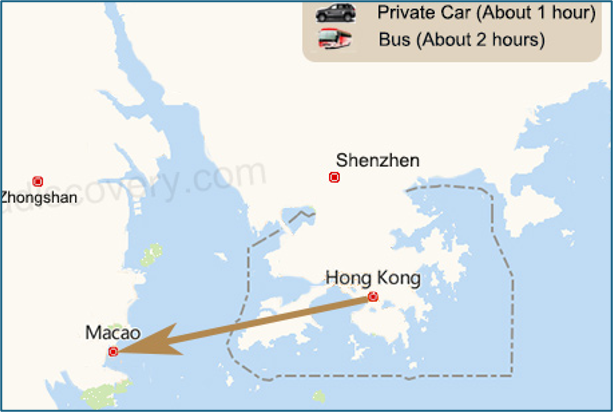
Visitors can travel to Macao by land, sea and air. You may take a direct or connecting flight to Macao International Airport and Hong Kong International Airport or transfer to other city routes.
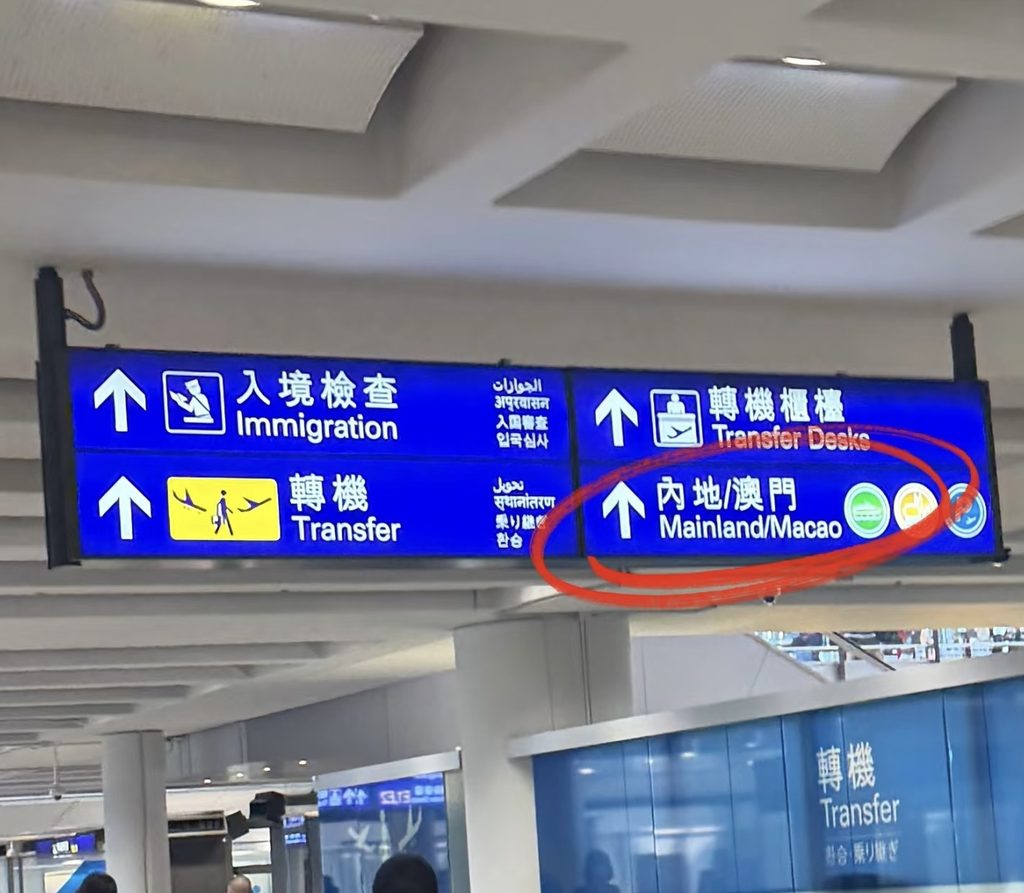
For travelers arriving at Hong Kong International Airport (before 9 pm), taking a transfer ferry or bus (at Transfer Area E2) is the most convenient way to travel from the HK airport to Macau, without going through immigration or baggage claim. Below are the signs to follow when looking for the ferry or coach service after landing at Hong Kong International Airport.
For travelers arriving at Hong Kong International Airport (after 9 pm), you can go through Hong Kong immigration, follow the “Mainland/Macao Transportation” sign to the 3rd floor, take a local bus (B4, use cash HKD) to the Hong Kong-Zhuhai-Macau Border, and take a shuttle Bus to the Macau Port. Finally, you can take a cab from the Macau Port to the hotels. Cabs will be available late at night.
Other visitors may travel to Macao by sea via Shun Tak Centre (Sheung Wan, Hong Kong), China (HK) Ferry Terminal (Tsim Sha Tsui, Kowloon, Hong Kong), Shekou (Shenzhen), and Fu Yong Ferry Terminal (Shenzhen Airport). Land crossings from Mainland China are made through the Border Gate on Macao Peninsula and the Lotus Bridge in Cotai. Details could be found via https://www.macaotourism.gov.mo/en/travelessential/before-you-travel/travelling-to-macao?tab=by-land
Local Transportation
Public transport
Taxi service:
Taxi is available through UBER or AMAP (高德) in Macao. To get to the conference venue, you can ask the driver to take you to the following address: University of Macau, N1 building (澳门大学 N1 聚贤楼).
If you are in the City or at the border crossing, you can also conveniently flag down a city cab or hop onto a taxi at a taxi rank. Special note: many taxis in Macau accept CASH ONLY; therefore, it is strongly advised to prepare some cash if you plan to take taxis.
The currency we use here is called Macanese Patacas, or MOP, although Hong Kong dollars are also widely accepted. Chinese QR code-based payments (WeChat and Alipay) are accepted by many drivers but not necessarily all. It is therefore recommended that you check with the driver beforehand if you plan to do so. Regarding the price, a trip from the HZMB Port to UM campus costs about 120-150 MOP, and a trip from the airport/Taipa Ferry Terminal to UM campus costs about 80-100 MOP.
Bus service
There are many bus routes connecting to campus, which are 71, 71S, 72, 73, N6 (overnight bus) and 701X. The entrance to the venue is right next to the bus station T554 (University Hall/大学会堂).
For Chinese travelers, Wechat and Alipay (using “乘車碼”) can be used. Each ride costs 6 MOP. Cash (6 MOP exact) is also accepted.
In general, it is strongly recommended that you purchase a local transportation card, called the mCard, which is available at almost all convenience stores across the city, including at the border crossings. The mCard is sold at a fixed price of 130 MOP, which includes 100 MOP available funds and a 30 MOP card fee. You can ride the bus and the Light Rapid Transit (our light rail/tram system) at a discounted price (3 or 4 MOP for bus, depending on the operator, and 4 MOP for LRT) with your mCard, or use it to pay at vending machines, convenience stores, etc. You can top up the cards at any convenience store with cash. Details can be found here: https://www.macaupass.com/card
The Bus Traveling System App launched by DSAT has a “Point to point” function. Users can use this app to check the real-time bus route information and check the travel plan to different locations. You are welcome to download this app (QR codes are enclosed below) or directly visit the DSAT website(http://www.dsat.gov.mo/dsat/subpage.aspx?a_id=1610598965)
What to see in Macao
Bus and taxi services serve as the primary means of public transportation in Macao. As a traveller, you will find it convenient and inexpensive to ride a bus around the territory, with local buses both modern and air-conditioned.
Macao’s rich and varied history has left its mark on the city, with vibrant reminders of its heritage as a Chinese fishing settlement intermingled with landmarks to its past as a Portuguese outpost. Around every corner, the city’s unique multicultural character invites visitors to explore and discover new facets of Macao.